

A lens for human health.
Grounded in evolutionary biology. Built for modern practice.
Professional development courses for practitioners seeking an intuitive framework for navigating modern wellness. Learn how ancestral health principles can help you evaluate treatment protocols, address root contributors to pain and chronic disease, and confidently guide patients through an increasingly noisy wellness landscape.
From Information Overload to a Coherent Framework
We have a framework to help you navigate the sea of information in the health and wellness industry. Watch the video to learn the story behind The Human Rehabilitation Project
The Story Behind The Framework
Healthcare has no shortage of interventions.
Practitioners are constantly exposed to new treatment approaches, protocols, technologies, and health trends.
Gut health.
Biohacking.
Longevity.
Breathwork.
Cold exposure.
Sauna.
Supplements.
Orthopedic devices.
Some are valuable. Some are not. Some are contradictory.
The challenge isn't finding more interventions.
The challenge is knowing how to evaluate them.
Without a coherent framework, healthcare becomes a collection of disconnected ideas and competing opinions.
That's why we teach ancestral health.
By understanding the environmental conditions that shaped human biology, practitioners gain a practical lens for evaluating health interventions and understanding what humans need to thrive.
Why does this matter?
We are living in an environment humans were never designed for.
As practitioners we know that chronic pain, metabolic disease, mental health disorders, and lifestyle-related illness are affecting a large proportion of our patients, and the community at large. Suggesting that aspects of modern living are misaligned with the biological requirements required for optimal human health.
Many patients struggle not because of a lack of treatment, but because their daily environment conflicts with the biological requirements that shaped human health over thousands of generations.
As practitioners, understanding this mismatch provides a powerful lens for improving patient outcomes.
Our Approach
We translate the science into practical clinical strategies that can be applied immediately with patients.
By understanding the paradigm of environmental pressures that shaped human biology, practitioners gain a coherent framework for supporting resilience, preventing chronic disease, and promoting long-term health.
The Human Rehabilitation Project
Rehabilitating human health through an evolutionary lens
A Framework for Modern Practice
A lot of courses teach you ‘what to think’. Our courses, while still providing some practical ideas, primarily teaches ‘how to think’ about health and treatment protocols.
They are evidence based and rooted in epigenetics and evolutionary biology.
Ancestral health is the study of how the environmental conditions that shaped human evolution, influence health today.
Rather than chasing trends or isolated interventions, we focus on the foundational factors that human physiology expects and depends upon.
Our courses provide practitioners with a practical framework for identifying and addressing the root lifestyle contributors to chronic disease and poor health.
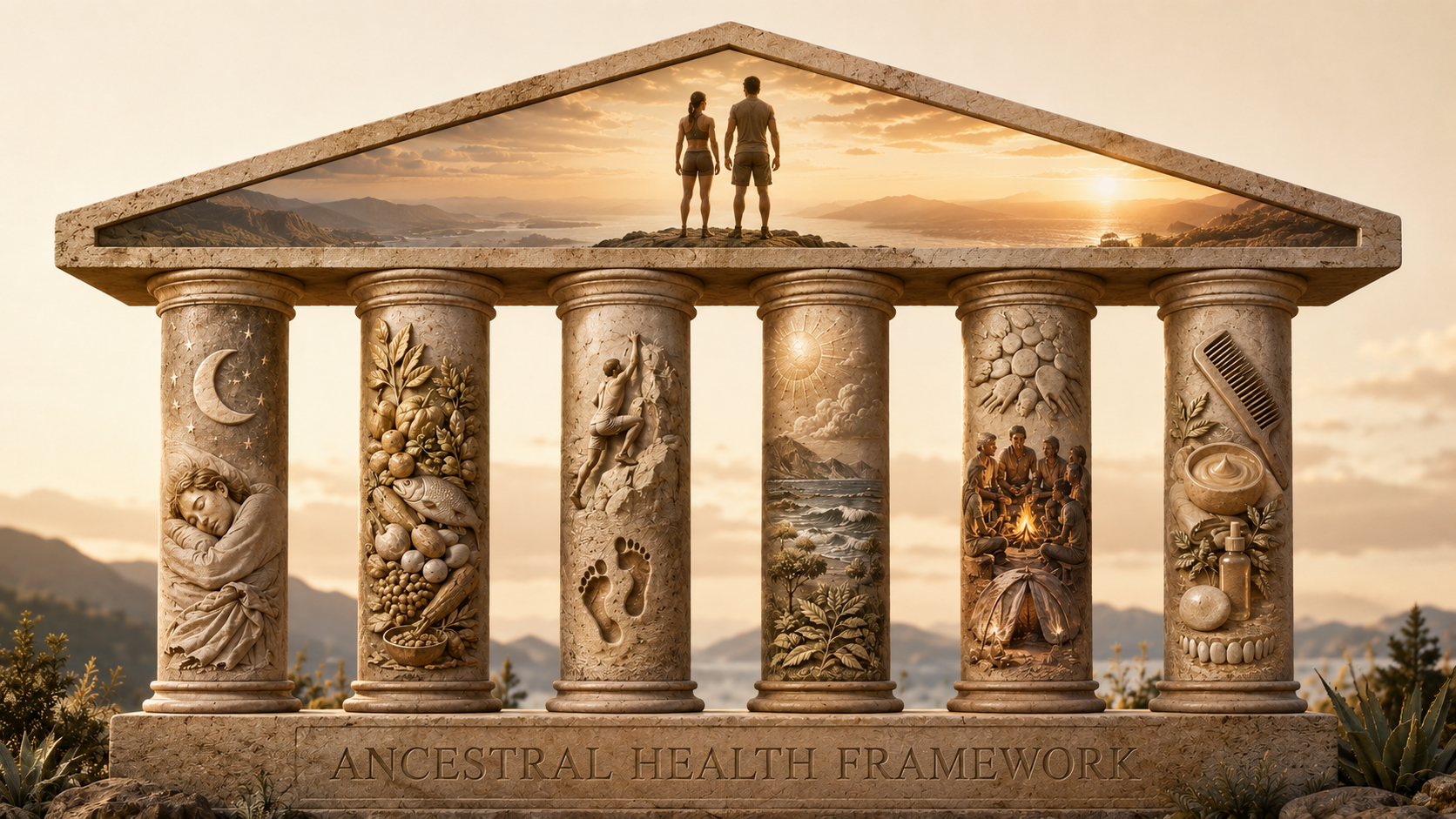
The Six Pillars of Human Health
One framework
Each pillar explores one of the major environmental inputs that shape human health, resilience and adaptation.
Movement
Explores how the human body is shaped by the way we move — or fail to move — in daily life. This pillar looks beyond exercise and examines feet, footwear, posture, floor-sitting, load, terrain, gait and the physical environments that condition the body.
Sleep
Examines sleep as a biological repair process shaped by light, darkness, temperature, safety and rhythm. This pillar explores how modern environments disrupt sleep and how practitioners can help patients restore deeper, more natural patterns of recovery.
Nutrition
Looks at nutrition through the lens of human biology, food environments and evolutionary mismatch. Rather than promoting one rigid diet, this pillar helps practitioners evaluate food quality, metabolic resilience, satiety, nutrient density and modern dietary disruption.
Exposure to Nature
Explores the importance of regular exposure to natural environmental signals — including sunlight, fresh air, heat, cold, wind, water, earth and seasonal variation. This pillar reframes the outdoors as an essential part of human regulation, resilience and wellbeing.
Mind and Tribe
Examines the role of social connection, belonging, meaningful work, story, ritual and psychological safety in human health. This pillar explores how isolation, chronic stress and modern social fragmentation affect the nervous system and long-term wellbeing.
Grooming
Reconsiders grooming through the lens of the skin, mouth and microbial ecosystem. This pillar explores how modern hygiene, synthetic chemicals and disinfectant-heavy habits may alter our relationship with the body’s natural protective systems.
Who This Training Is For
Practitioners frustrated by recurring symptoms and poor long-term outcomes.
Practitioners seeking to move beyond symptom-focused care.
Practitioners who want to confidently discuss modern health topics with informed patients.
Practitioners looking for a coherent, evidence-informed framework that is practical, intellectually consistent, and easy to apply in clinical practice.
Patient outcomes transformed.
Join a growing community of allied health professionals learning to apply ancestral health principles in a modern clinical setting.
Be a part of the project
-

What is Ancestral Health?
An intellectual discussion: Can Ancestral Health can be used as framework for assessing health trends and treatment protocols?
-

Online Courses
Find out what is included.
-

Case Study: Plantar Fasciitis. A practical workup applying the Ancestral Health framework.
See exactly how the Ancestral Health Framework guides clinical reasoning, assessment, and rehabilitation in a real-world case.